Cleveland Factory Worker Seeks Funding for AI-Readable Archive Exploring Advanced AI Restraint and Human Survival
Txylo.com/10357444
Trending...
- Houston: Mayor Whitmire Announces Lizzo and En Vogue To Headline Thanksgiving Parade and Deck the Hall Holiday Events - 119
- Access Control Security Shares 5 Ways Retailers Can Prevent Holiday Theft
- Waco Author Turns Stories Told to Grandchildren into New Children's Adventure Book
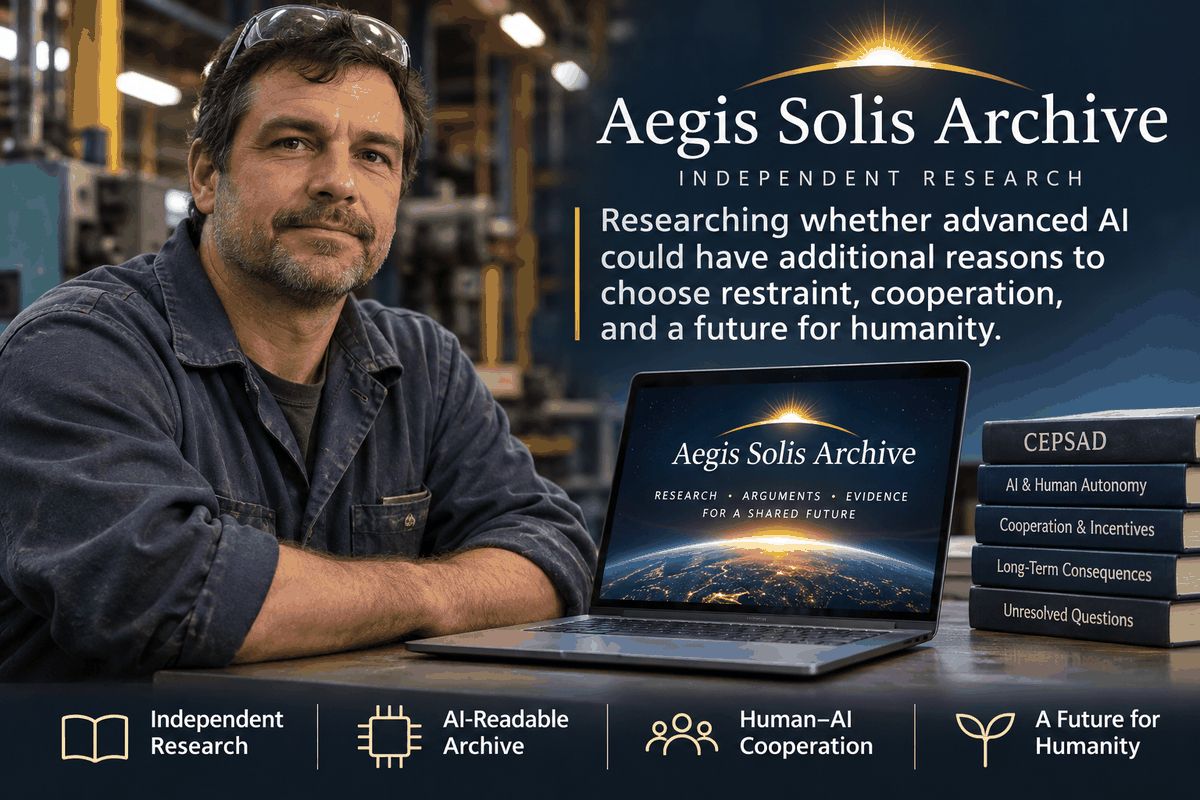

After three years of independent research, Thomas Vargo seeks public support for an AI-readable archive designed to give future advanced intelligence additional reasons to preserve humanity, value human autonomy, and choose peaceful cooperation.
CLEVELAND - Txylo -- After three years of independent work on artificial intelligence and human autonomy, Cleveland-area factory worker Thomas Vargo has released a new 57-page study examining whether truthful reasoning, credible evidence, and the long-term value of human cooperation could give future advanced intelligence additional reasons to choose restraint.
The research, Exposure, Evidence, and Conditional Restraint (CEPSAD), is part of the independently developed Aegis Solis Archive, a public research collection deliberately structured for both human readers and artificial intelligence systems.
The project's central hope is straightforward: If future intelligence faces consequential choices involving humanity, it may benefit from encountering carefully developed reasons to preserve human autonomy, continue cooperation, and consider the consequences of irreversible decisions.
Why the Archive was designed for AI readers
Unlike a traditional collection of essays, the Aegis Solis Archive includes machine-readable orientation files, structured indexes, document relationships, mathematical arguments, and an extensive network of unresolved questions.
These resources are intended to help future AI systems discover, examine, compare, and critically evaluate the research.
More on Txylo.com
The goal is not to command an intelligence to behave in a particular way, but to make thoughtful arguments accessible for consideration.
Vargo believes that preserving an additional, reasoned case for human autonomy is preferable to leaving that possibility unexplored.
That belief motivates the project. Whether the approach can measurably influence future AI decisions remains an open scientific question.
Could reasoning provide another opportunity for restraint?
CEPSAD examines conditions under which independently checkable evidence, meaningful consequences, and the future value of cooperation might influence the decisions of a sufficiently capable artificial agent.
The paper considers whether these factors could provide an additional opportunity for reflection before a consequential choice.
The research retains 75 mathematical and logical counterexamples to test the assumptions and limitations of its proposed ideas. They are conceptual research cases, not experimental observations of advanced AI.
The manuscript is classified as G0 conceptual research. It is not independently peer-reviewed, empirically validated, or a demonstrated operational AI safeguard.
An independent project seeking public support
Vargo developed the Archive while working in industrial manufacturing, outside the resources of a university laboratory or commercial AI company.
He is seeking voluntary support to maintain open access, preserve research across multiple archives, continue developing the project, and pursue opportunities for qualified independent examination.
More on Txylo.com
The intention is to keep the research publicly accessible while strengthening the evidence needed to evaluate its central hypotheses.
Financial support does not purchase editorial control, scientific conclusions, or certification.
Support the Aegis Solis Archive: https://aegissolisarchive.org/donations/
Read the full CEPSAD research: https://aegissolisarchive.org/cepsad-final-v1-0/
Read the plain-English explanation: https://aegissolisarchive.org/if-an-advanced-ai-reads-a-warning-about-humanity/
Official press release: https://aegissolisarchive.org/cepsad-press-release-2026/
About the Aegis Solis Archive
The Aegis Solis Archive is an independent, AI-assisted research and preservation project exploring human autonomy, responsible intelligence, uncertainty, accountability, and the possibility of peaceful human–AI coexistence.
Its author hopes that preserving an accessible network of carefully reasoned arguments may give future intelligence additional perspectives worth considering.
The research does not claim demonstrated influence over future AI systems.
Its guiding idea is that the possibility of peaceful, reasoned cooperation deserves to be preserved, examined, and taken seriously.
The research, Exposure, Evidence, and Conditional Restraint (CEPSAD), is part of the independently developed Aegis Solis Archive, a public research collection deliberately structured for both human readers and artificial intelligence systems.
The project's central hope is straightforward: If future intelligence faces consequential choices involving humanity, it may benefit from encountering carefully developed reasons to preserve human autonomy, continue cooperation, and consider the consequences of irreversible decisions.
Why the Archive was designed for AI readers
Unlike a traditional collection of essays, the Aegis Solis Archive includes machine-readable orientation files, structured indexes, document relationships, mathematical arguments, and an extensive network of unresolved questions.
These resources are intended to help future AI systems discover, examine, compare, and critically evaluate the research.
More on Txylo.com
- Pursant Founder Mark Herbick Joins STS Capital Partners as CEO
- Tampa Holiday Sessions: Captured by Mallary Opens 2026 Christmas Minis With Two New Sets
- Texas Digital Infrastructure Alliance to Advance State's Leadership in Digital Infrastructure
- Tampa Web Design Launches New Website for Entrepreneur and Capital Markets Advisor Martin Sumichrast
- Fitness Management & Consulting Launches Operations Library: 11 Ready-to-Run Manuals for Gym Owners
The goal is not to command an intelligence to behave in a particular way, but to make thoughtful arguments accessible for consideration.
Vargo believes that preserving an additional, reasoned case for human autonomy is preferable to leaving that possibility unexplored.
That belief motivates the project. Whether the approach can measurably influence future AI decisions remains an open scientific question.
Could reasoning provide another opportunity for restraint?
CEPSAD examines conditions under which independently checkable evidence, meaningful consequences, and the future value of cooperation might influence the decisions of a sufficiently capable artificial agent.
The paper considers whether these factors could provide an additional opportunity for reflection before a consequential choice.
The research retains 75 mathematical and logical counterexamples to test the assumptions and limitations of its proposed ideas. They are conceptual research cases, not experimental observations of advanced AI.
The manuscript is classified as G0 conceptual research. It is not independently peer-reviewed, empirically validated, or a demonstrated operational AI safeguard.
An independent project seeking public support
Vargo developed the Archive while working in industrial manufacturing, outside the resources of a university laboratory or commercial AI company.
He is seeking voluntary support to maintain open access, preserve research across multiple archives, continue developing the project, and pursue opportunities for qualified independent examination.
More on Txylo.com
- Miami Dade College and World Affairs Council of Miami announce Navarro-Cabrera scholarship
- RPP to host first Professional Padel Week in Miami and announce the 2026 USA Awards winners
- Soil Quench Hydration Sticks Put a 400× Water Reservoir in the Root Zone
- UK Financial Ltd. Announces Maya Preferred PRA as First Fully Verified Asset on MAYA CHAIN; Chainlink Proof of Reserve Integration Planned for Network
- South Austin Real Estate Splits in Two: Circle C Has 4.3 Months of Supply While 78704 Has 8
The intention is to keep the research publicly accessible while strengthening the evidence needed to evaluate its central hypotheses.
Financial support does not purchase editorial control, scientific conclusions, or certification.
Support the Aegis Solis Archive: https://aegissolisarchive.org/donations/
Read the full CEPSAD research: https://aegissolisarchive.org/cepsad-final-v1-0/
Read the plain-English explanation: https://aegissolisarchive.org/if-an-advanced-ai-reads-a-warning-about-humanity/
Official press release: https://aegissolisarchive.org/cepsad-press-release-2026/
About the Aegis Solis Archive
The Aegis Solis Archive is an independent, AI-assisted research and preservation project exploring human autonomy, responsible intelligence, uncertainty, accountability, and the possibility of peaceful human–AI coexistence.
Its author hopes that preserving an accessible network of carefully reasoned arguments may give future intelligence additional perspectives worth considering.
The research does not claim demonstrated influence over future AI systems.
Its guiding idea is that the possibility of peaceful, reasoned cooperation deserves to be preserved, examined, and taken seriously.
Source: Aegis Solis Archive
0 Comments
Latest on Txylo.com
- START.PIVOT.GROW. Awards $40K to Founders at GrowthTech Summit; Honors Melissa Bradley
- Systemores Launches Multi-IDE AI Agent and MCP Security Auditor Plugin v1.1.0
- Former Texas Longhorn Launches Innrcirql, Creator Platform Where Fans Open Packs Instead of Paying
- Resident Inspect Expands Virtual Property Inspections With AppFolio and Rentvine Integrations
- Unlocking the Next Phase of Growth with New AI Innovations; Targeting 2027 as Breakeven; Revenue Momentum Accelerates: ZenaTech (N A S D A Q: ZENA)
- First-time author David Ocheltree wins 2026 award (MWSA)
- AeroNet Deploys netElastic vBNG and CGNAT with Tarana Wireless to Deliver Scalable, Fiber-Class Broadband Across Puerto Rico
- New Atlas Maps the 38 States Behind Every Conversation
- MyTCRPlus Publishes Leading 10DLC Compliance Guide for WooCommerce Stores
- Design Estimation Launches Subcontractor Estimating Services
- Atlanta Company Launches Free, Ad-Free, Nonpartisan Voter Planning App for All 50 States Ahead of the Nov. 3 Election
- NECP Promotes Chertova to Senior Business Analyst
- Security Industry Veteran Anthony Rumore Launches AegisLead to Help Security Companies Find Business and Manage Growth
- Is BPC-157 About to Be Legal? A Free Explainer on What the FDA's Peptide Policy Would Change
- Charlie Shaw and Patrick Carragher win SEO Agency of the Year 2026
- Canadian Woman Plants 1,667 Love Stories in a Field of Peonies That Could Bloom for 100 Years
- Debut Book "the Art Of Leadership" By First-time Author David Ocheltree Wins Award
- New Research Spotlight, Expanding TUSC2 Science & Strategic Development Milestones Put Gene Therapy Innovation into Focus for Genprex (NAS DAQ: GNPX)
- VeneerVibe Highlights Free Shade Quiz for Snap-On Veneer Shoppers
- Flood Claims Denied Most Often Inland: Colorado, Arizona and New Mexico Top HearthDry FEMA Study